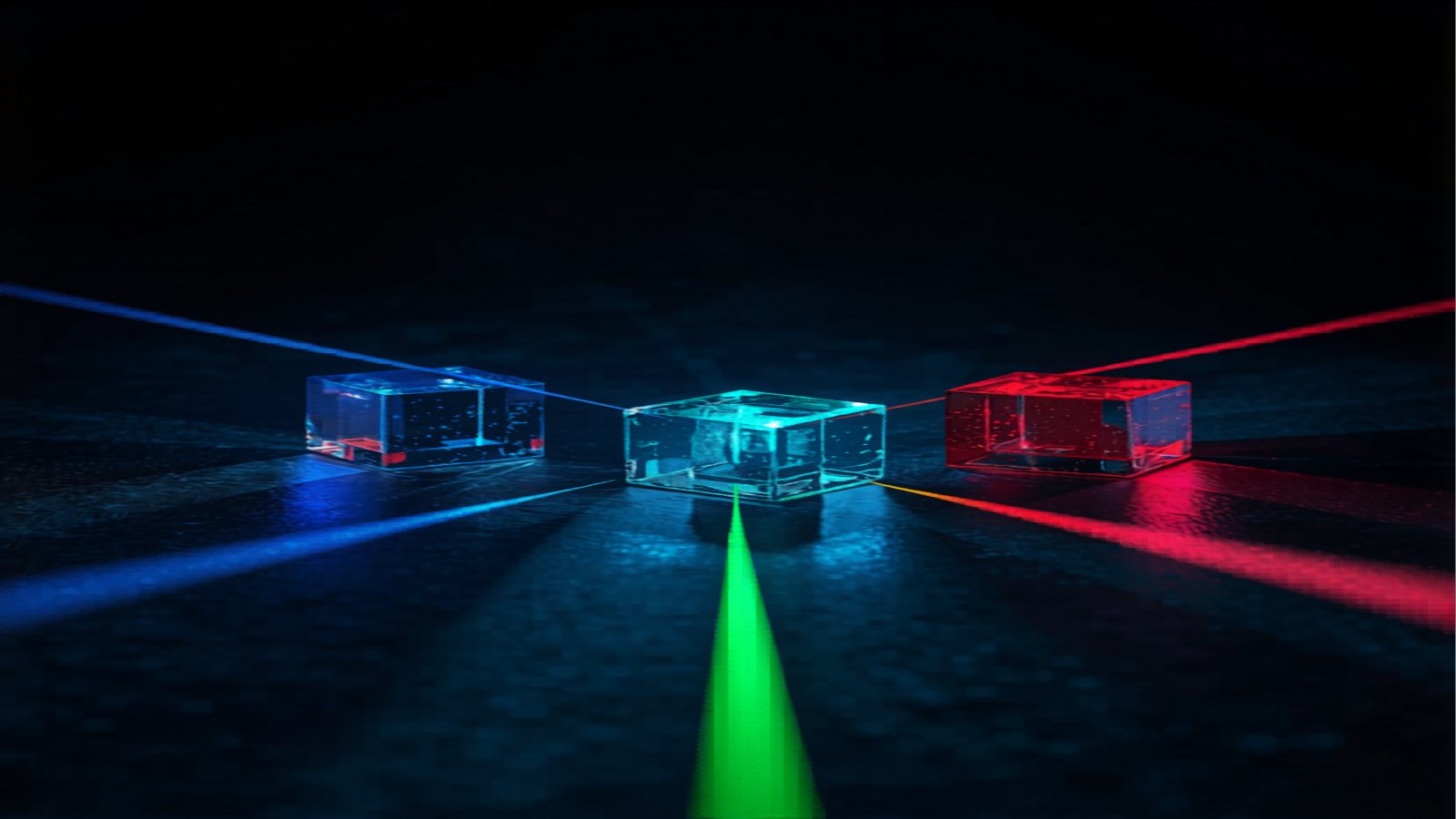
Beam Splitters
Polarizing and non-polarizing beam splitters in cube, plate, and pellicle configurations. For interferometry, power monitoring, and wavelength combining.
Polarizing Beam Splitter Cubes
High extinction ratio PBS cubes that split light into s- and p-polarization components. Essential for interferometry, laser isolation, and projection optics.
- ● Extinction ratio >1000:1
- ● Broadband or laser-line coated
- ● Cemented or optically contacted
50/50 Non-Polarizing Beam Splitters
Split incident light into two equal-intensity beams regardless of polarization. Available as cubes or plates for interferometry and imaging.
- ● 50/50 split ratio (+/-5%)
- ● Minimal polarization dependence
- ● Cube or plate format
Plate Beam Splitters
Thin flat-plate beam splitters with partial-reflection coatings. Lower cost and less ghosting than cubes, but introduce beam offset.
- ● Various R/T ratios
- ● Minimal wavefront distortion
- ● Wedged options to reduce ghosting
Dichroic Beam Splitters
Wavelength-selective beam splitters that reflect one spectral band while transmitting another. Core component in fluorescence microscopes and RGB projection.
- ● Sharp spectral transitions
- ● High R and T in pass bands
- ● Custom edge wavelengths
Laser Beam Splitters
Beam splitters optimized for specific laser wavelengths with high damage thresholds. Designed for beam sampling, power monitoring, and beam combining.
- ● High LIDT coatings
- ● AR coated on exit face
- ● Common laser wavelengths in stock
Pellicle Beam Splitters
Ultra-thin membrane beam splitters that eliminate ghost reflections. Ideal for imaging, interferometry, and applications where ghosting is unacceptable.
- ● 2-5 micron membrane thickness
- ● No ghost reflections
- ● Fragile -- handle with care
Beam Splitter Types Compared
| Product | Format | Ghost Reflections | Beam Offset | Damage Threshold | Cost | Best For | |
|---|---|---|---|---|---|---|---|
| Cube (PBS) | Cemented cube | None (internal) | Zero | Moderate | $$$ | Polarization splitting, interferometry | |
| Plate | Flat plate (45 deg) | Low (wedged) | Small shift | High | $ | Laser sampling, cost-sensitive | |
| Pellicle | Thin membrane | None | Negligible | Low | $$ | Ghost-free imaging |
How Beam Splitters Work
A beam splitter divides an incoming light beam into two paths. The split can be based on amplitude (partial reflection), polarization state, or wavelength. Understanding which mechanism you need determines which type to buy.
Polarizing beam splitters (PBS) use a multilayer dielectric coating to transmit p-polarized light and reflect s-polarized light at 90 degrees. Extinction ratios of 1000:1 or better are standard. Used in interferometers, optical isolators, and anywhere you need clean polarization separation.
Non-polarizing beam splitters maintain the input polarization state in both output beams. The 50/50 split ratio is most common, but ratios from 10/90 to 90/10 are available. Critical for applications where polarization must be preserved.
For high-power lasers, pay attention to the laser-induced damage threshold (LIDT). Plate beam splitters generally handle more power than cemented cubes because the coating interface is exposed to air rather than cement. For very high power, consider uncoated wedge windows at Brewster's angle.
Request a Custom Quote
Need custom specs, bulk pricing, or OEM quantities? Tell us what you need.
Quote request submitted!
We will be in touch within 1 business day.
Something went wrong.
Please email us directly at quotes@photonpicks.com