Side-by-Side Comparison
| Product | Construction | Ghost Reflections | Beam Offset | Damage Threshold | Cost | Best Use | |
|---|---|---|---|---|---|---|---|
| Cube Beam Splitter | Two prisms cemented at hypotenuse | None (internal reflection) | Zero | Moderate (cement limits) | $$$ | Interferometry, imaging, polarization splitting | |
| Plate Beam Splitter | Flat substrate with partial-R coating | Yes (from back surface) | Small lateral shift | High (no cement) | $ | Laser beam sampling, high power | |
| Pellicle Beam Splitter | 2-5um nitrocellulose membrane | Negligible | Negligible | Low (fragile) | $$ | Ghost-free imaging, microscopy | |
| Dichroic Beam Splitter | Substrate with wavelength-selective coating | Manageable (wedged substrate) | Depends on thickness | Moderate to high | $$ | Wavelength separation, fluorescence, beam combining |
Cube Beam Splitters
A cube beam splitter is made from two right-angle prisms cemented together at the hypotenuse, with a beam splitting coating at the interface. The transmitted and reflected beams exit at 90 degrees through the cube faces with zero beam offset and no ghost reflections -- because all reflections happen at the internal coating interface.
Pros: Zero offset, no ghosts, easy to mount, available as polarizing (PBS) or non-polarizing (NPBS).
Cons: The cement layer limits damage threshold (typically <1 J/cm2 for standard cement). Larger cubes get expensive and heavy. Wavefront quality depends on cement uniformity. For very high power, optically contacted (no cement) cubes are available at premium cost.
Plate Beam Splitters
A plate beam splitter is a flat glass substrate with a partial-reflection coating on one side and an AR coating on the other. Used at 45 degrees, it reflects part of the beam at 90 degrees and transmits the rest straight through.
Pros: Simple, low cost, high damage threshold (no cement), excellent wavefront quality, easy to get in custom R/T ratios.
Cons: The back surface creates a secondary (ghost) reflection. Wedging the substrate (typically 0.5 to 3 degrees) separates the ghost from the primary beam but does not eliminate it. The transmitted beam also gets a small lateral offset proportional to substrate thickness.
Pellicle Beam Splitters
A pellicle is an ultra-thin membrane (2 to 5 micrometers thick) stretched over a metal frame. Because the membrane is much thinner than a wavelength of light, ghost reflections from the back surface are shifted by less than a wavelength and are effectively invisible.
Pros: Zero ghost reflections, negligible beam offset, minimal chromatic effects.
Cons: Extremely fragile -- acoustic vibrations, air currents, and physical contact can destroy them. Low damage threshold. The membrane is acoustically sensitive, making them unsuitable for environments with vibration. Not recommended for pulsed lasers.
Dichroic Beam Splitters
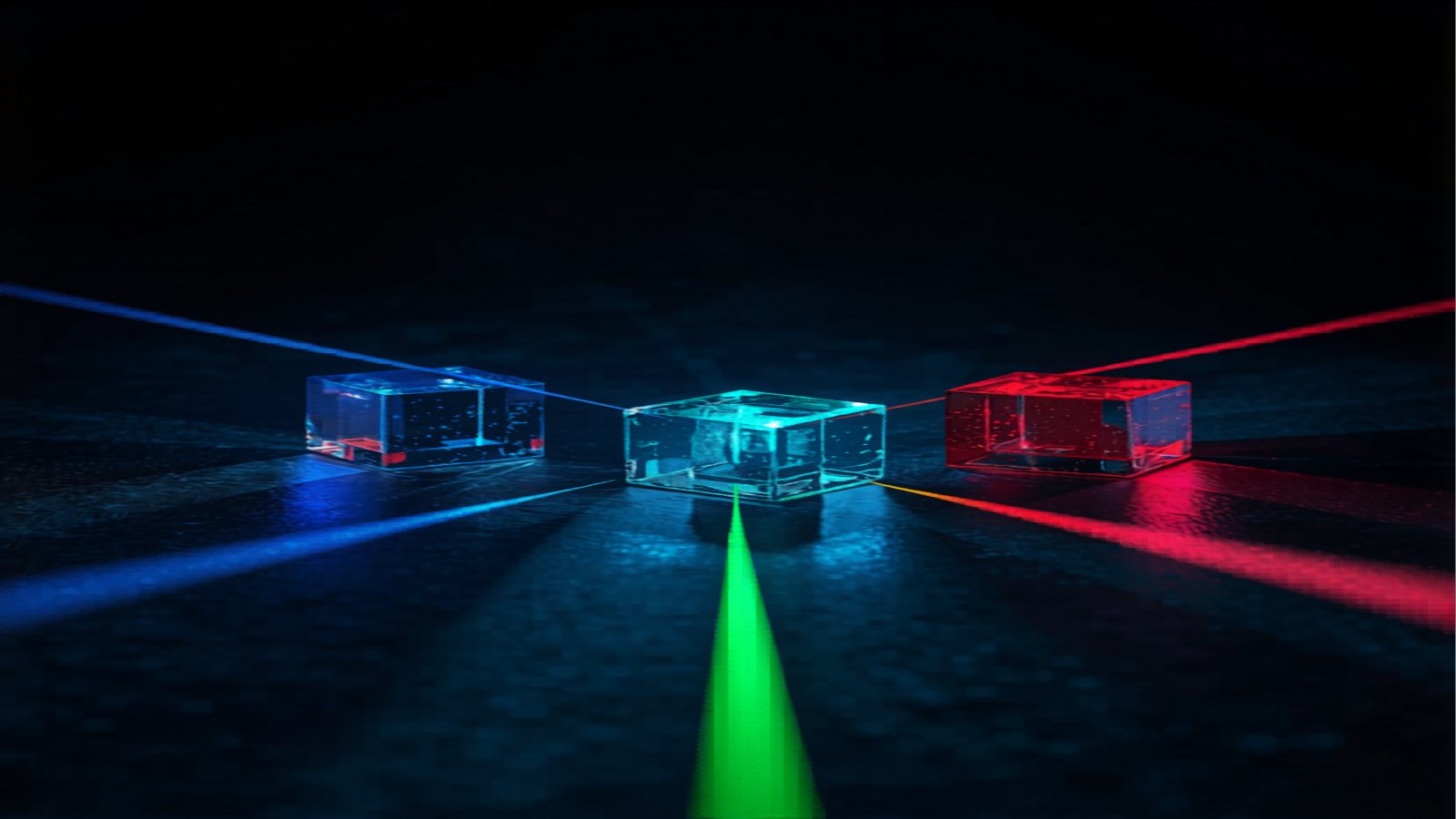
Unlike amplitude-splitting beam splitters, dichroic beam splitters separate light by wavelength. A dichroic coating reflects a specific spectral band while transmitting the complementary band. This is how fluorescence microscopes separate excitation from emission, and how RGB projectors combine three color channels.
Key spec: edge steepness. A good dichroic transitions from reflection to transmission in <5nm. Modern hard-coated dichroics from manufacturers like Chroma, Semrock, and Alluxa achieve very steep edges with high durability.
Decision Flowchart
Do you need wavelength separation? Yes --> Dichroic beam splitter
Do you need polarization separation? Yes --> Polarizing beam splitter cube (PBS)
Are ghost reflections unacceptable? Yes --> Pellicle (low power) or cube (higher power)
Is damage threshold the priority? Yes --> Plate beam splitter
Is cost the priority? Yes --> Plate beam splitter
Default for general lab use: Non-polarizing cube beam splitter
Request a Custom Quote
Need custom specs, bulk pricing, or OEM quantities? Tell us what you need.
Quote request submitted!
We will be in touch within 1 business day.
Something went wrong.
Please email us directly at quotes@photonpicks.com